- 31b Great Western Road Dorchester Dorset DT1 1UF
- quotes@myhomesolar.uk

Call Us
0800 193 3933
For many business owners across Dorset, Bournemouth and the Midlands, energy has become one of the most unpredictable operational costs in modern commerce. Electricity prices continue to fluctuate, sustainability expectations are growing, and companies are under increasing pressure to reduce expenditure without compromising productivity. Against this backdrop, commercial solar panels have emerged as one of the most practical and financially intelligent investments available to British businesses.
The answer is more nuanced than a simple yes or no. In many cases, commercial solar systems can supply the majority, or even the entirety, of a company’s electricity needs. However, this depends upon several important factors including energy consumption, roof size, operating hours, battery storage capacity and the type of business involved.
For warehouses, agricultural sites, manufacturing facilities, offices and retail premises, commercial solar panels are increasingly transforming how organisations manage energy. Businesses throughout Dorset, Bournemouth and the Midlands are now reducing reliance upon the National Grid while protecting themselves from rising utility costs.
At My Home Solar, we help companies design intelligent commercial solar solutions tailored to their specific operational demands, enabling businesses to move closer towards genuine energy independence.
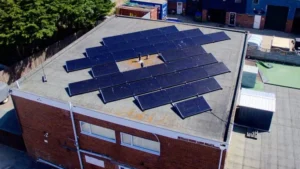
Commercial solar panels convert sunlight into usable electricity through photovoltaic technology. Unlike domestic systems, commercial installations are designed to manage significantly larger energy demands and are often paired with battery storage systems for improved efficiency.
During daylight hours, the panels generate electricity that can immediately power equipment, lighting, machinery, computers, refrigeration systems and other operational infrastructure.
Any excess electricity can either be stored within commercial battery systems or exported back to the grid through export tariff schemes.
For many businesses, the greatest advantage lies in the fact that peak operating hours frequently coincide with peak solar production. Warehouses, offices and industrial units generally consume the most electricity during the daytime, precisely when solar generation is strongest.
This natural alignment allows commercial solar panels to dramatically reduce grid dependence.
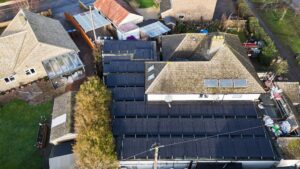
In some circumstances, yes.
Certain businesses can operate almost entirely from solar energy, particularly during spring and summer months. Others may still require partial support from the grid during winter or periods of exceptionally high demand.
Several key variables determine whether a commercial property can achieve full energy independence.
The first consideration is how much electricity the business consumes each day.
A small office with moderate energy usage may be fully powered by a carefully designed solar array. By contrast, a large manufacturing facility operating heavy machinery around the clock may require supplementary grid electricity during peak demand periods.
Businesses with consistent daytime usage are generally the best candidates for solar energy optimisation.
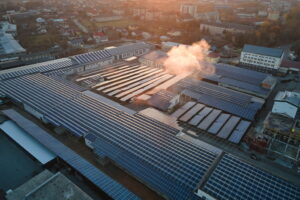
Roof size plays a critical role in determining how much electricity can be generated.
Large warehouses, agricultural buildings and industrial premises often possess expansive roof areas that are ideal for commercial solar installation. These buildings can accommodate significantly larger systems capable of generating substantial energy output.
A well positioned commercial roof in Bournemouth or Dorset can produce remarkable levels of electricity throughout the year, particularly when fitted with high efficiency panels such as SunPower Maxeon systems.
Commercial battery storage has transformed the effectiveness of solar energy systems.
Without batteries, unused solar electricity generated during daylight hours may simply be exported back to the grid. While export schemes offer financial benefits, battery systems allow businesses to store surplus electricity for later use.
This stored energy can then power operations during evenings, overnight periods or cloudy weather.
Advanced battery systems such as Tesla Powerwall and Growatt battery solutions now enable businesses to maximise self consumption while reducing dependence upon external suppliers.
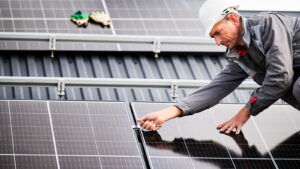
Although almost every commercial property can benefit from solar technology, certain sectors tend to achieve particularly strong returns.
Warehouses often possess enormous roof surfaces and substantial daytime electricity consumption. Lighting, conveyor systems, security equipment and charging infrastructure can all be powered effectively through solar generation.
Because warehouses frequently operate during daylight hours, solar production aligns exceptionally well with energy demand.
Farms throughout Dorset and the Midlands are increasingly investing in commercial solar systems to power refrigeration equipment, irrigation systems, livestock facilities and machinery.
Agricultural buildings typically provide excellent roof space while rural properties may benefit significantly from greater energy independence.
Industrial premises consume considerable electricity, making long term savings highly attractive. Although factories may still require grid support during intensive production periods, commercial solar systems can offset a significant proportion of operational costs.
Commercial offices and retail units are particularly well suited to solar energy due to predictable daytime usage patterns. Lighting, heating systems, air conditioning and computing infrastructure can often be substantially supported through solar generation.
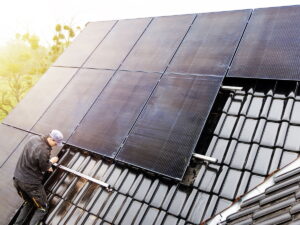
Battery storage is rapidly becoming essential for businesses seeking greater energy autonomy.
A commercial solar system without batteries still delivers excellent savings. However, storage solutions significantly enhance overall efficiency by retaining surplus electricity for later use.
Consider a warehouse generating excess electricity during the afternoon. Without batteries, this electricity may simply be exported. With battery storage, that energy can instead power evening operations, overnight refrigeration or early morning activity.
This improves energy independence while increasing return on investment.
Tesla Powerwall systems are renowned for intelligent energy management and sleek integration. They allow businesses to monitor energy production, consumption and storage in real time while automatically optimising efficiency.
Growatt battery solutions provide scalable storage suitable for many commercial applications. They offer strong reliability, flexible capacity and effective integration with commercial solar PV systems.
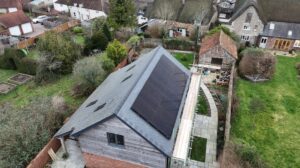
One of the most compelling reasons businesses invest in commercial solar panels is the potential for long term financial savings.
Electricity represents a substantial overhead for many organisations. By generating electricity on site, businesses can reduce exposure to rising utility prices while stabilising operational expenditure.
Although savings vary according to system size and consumption, many businesses experience dramatic reductions in energy costs over time.
| Business Type | Estimated Annual Savings Potential |
|---|---|
| Small Office | £4,000 to £8,000 |
| Retail Premises | £6,000 to £15,000 |
| Warehouse | £15,000 to £40,000 |
| Agricultural Site | £10,000 to £35,000 |
| Manufacturing Facility | £25,000 to £100,000+ |
Commercial solar systems also provide excellent long term value because modern panels often continue performing efficiently for twenty five years or longer.
Most businesses recover their solar investment within several years through energy savings alone.
Payback periods depend upon:
As energy costs continue to rise across Britain, commercial solar ROI becomes increasingly attractive.
Businesses that invest today may protect themselves from decades of volatile electricity pricing.
Commercial solar panels are not solely about reducing costs. They also strengthen environmental credibility.
Customers, investors and commercial partners increasingly favour businesses that demonstrate genuine sustainability commitments.
By adopting renewable energy, companies can:
For many businesses in Bournemouth, Dorset and the Midlands, sustainability is rapidly becoming both a commercial advantage and a reputational necessity.
Businesses considering commercial solar installation may also benefit from various financial incentives and tax advantages.
These can include:
Commercial finance solutions are also increasingly available, making solar installation accessible without large upfront expenditure.
At My Home Solar, we help businesses understand the financial landscape surrounding commercial solar investment and identify the most practical route forward.
For most businesses, the evidence is increasingly difficult to ignore.
Commercial solar panels offer:
While not every business will become entirely self sufficient, many can significantly reduce reliance upon traditional energy suppliers.
With intelligent design, quality battery storage and efficient solar technology, some businesses can operate with remarkably limited dependence upon the grid.
Across Dorset, Bournemouth and the Midlands, commercial property owners are increasingly recognising the strategic advantages of renewable energy.
Warehouses are reducing operational costs.
Agricultural businesses are stabilising energy expenditure.
Retail premises are improving sustainability credentials.
Manufacturers are protecting themselves from volatile electricity markets.
Commercial solar panels are no longer viewed as a niche environmental initiative. They are now considered a serious long term business investment.
At My Home Solar, we specialise in designing bespoke commercial solar systems that help businesses reduce costs, improve sustainability and move towards genuine energy independence.
Whether you operate a warehouse in the Midlands, an office in Bournemouth or an agricultural site in Dorset, our team can develop a commercial solar solution tailored specifically to your operational requirements.
We provide:
If you are considering commercial solar panels for your business, now is the ideal time to explore the possibilities.
Contact My Home Solar today for a free commercial solar survey and discover how renewable energy could transform your business operations.
In some cases, yes. Businesses with sufficient roof space, efficient energy usage and battery storage may achieve near complete energy independence during certain periods of the year.
Most modern commercial solar panels remain highly effective for twenty five years or longer with proper maintenance.
Battery systems are not essential, but they significantly improve energy independence and efficiency by storing excess electricity for later use.
Warehouses, farms, factories, offices and retail premises often achieve particularly strong returns due to consistent daytime electricity usage.
For many businesses, commercial solar systems deliver substantial long term savings while protecting against rising electricity prices.