- 31b Great Western Road Dorchester Dorset DT1 1UF
- quotes@myhomesolar.uk

Call Us
0800 193 3933
When homeowners begin exploring solar panels for your home, the focus is often on the panels themselves. Brands such as Canadian Solar panels and Q Cells naturally attract attention, yet one of the most important decisions in any home solar energy panels system is the choice of inverter. Without an inverter, solar power generated on your roof cannot be used in your home at all.
Understanding the difference between string inverters and microinverters is essential for anyone considering solar panels for home UK installations. The right choice can influence performance, reliability, future expansion and overall value, particularly across varied regions of England such as the Midlands and the South Coast.
This guide explains how these two inverter types work, how solar power work in practical terms, and which option may be best suited to your home.

Before comparing inverter types, it helps to understand the basics of how do solar power work.
Solar panels for your home capture sunlight and convert it into direct current electricity. Homes, however, use alternating current electricity. The inverter performs the vital role of converting this direct current into usable alternating current so it can power lighting, appliances and heating systems.
Any excess electricity will be exported back to the grid or stored in a battery system such as a Growatt battery for later use. The efficiency and reliability of this conversion process depends heavily on the type of inverter installed.
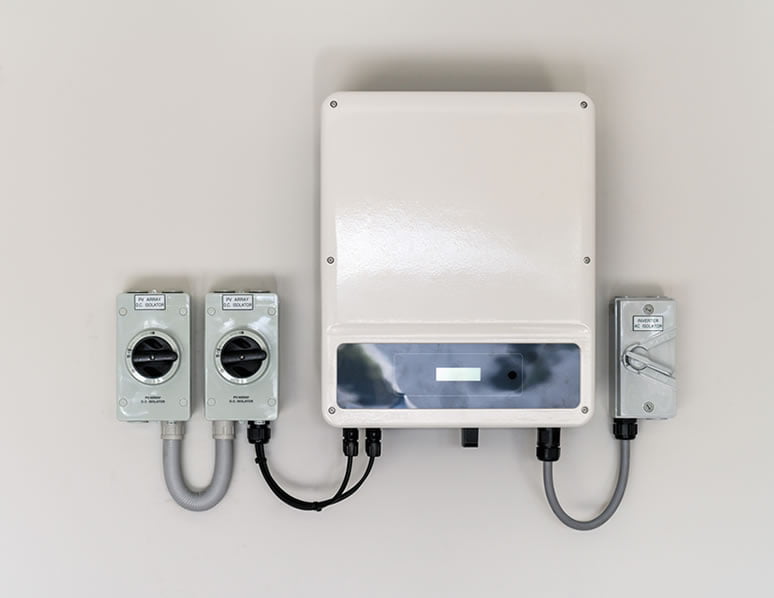
A string inverter is the most traditional and widely used inverter type in the UK. In this system, solar panels are wired together in series, forming what is known as a string. The electricity generated by all panels flows to a single central inverter, which converts it into usable power.
String inverters are commonly paired with systems using panels from manufacturers such as Canadian Solar and Q Cells, and are often combined with advanced technologies from brands such as SolarEdge or a Fronius solar inverter.
String inverters are valued for their simplicity and cost effectiveness. Because there is only one main inverter unit, installation is usually straightforward and maintenance access is easier.
They are particularly well suited to properties with simple roof layouts where all panels face the same direction and experience similar sunlight levels throughout the day. Many homes across the Midlands with uniform roof structures benefit from this approach.
String inverter systems are also compatible with battery storage and can support both residential installations and business solar panel systems when designed correctly.
The main limitation is that the performance of the entire system is influenced by the weakest panel. If one panel is shaded or underperforming, it can reduce the output of the whole string.
This can be more noticeable on the South Coast or in urban environments where chimneys, trees or neighbouring buildings cast intermittent shadows.
Microinverters work in a fundamentally different way. Instead of a single central inverter, each solar panel has its own small inverter attached directly to it. These are most commonly associated with Enphase and Enphase Energy systems.
Each panel converts electricity independently, meaning the performance of one panel does not affect the others.
Microinverters offer excellent performance optimisation. Because each panel operates on its own, shading or dirt on one panel does not reduce the output of the entire system.
This makes microinverters ideal for complex roof layouts, properties with multiple roof angles, or homes that experience partial shading at different times of day.
Microinverters also provide detailed panel level monitoring, allowing homeowners to track performance with precision and quickly identify any issues.
The main drawback is cost. Microinverters typically have a higher upfront price due to the increased number of components.
Maintenance can also be more involved since the inverters are located on the roof rather than in a single accessible unit. However, many Enphase Energy products are known for long warranties and strong reliability, which offsets this concern for many homeowners.
When comparing string inverters and microinverters, efficiency is not simply about conversion rates. It is about how consistently the system performs across real world conditions.
String inverters perform very well on simple roofs with minimal shading. When paired with power optimisers such as SolarEdge technology or a high quality Fronius solar inverter, they can deliver excellent long term results.
Microinverters shine in less predictable environments. Homes with dormers, extensions or varied roof orientations often see higher overall energy yields from microinverter systems.
For most homeowners, cost remains a key factor. String inverter systems generally have a lower upfront cost, making them attractive for standard installations and larger arrays.
Microinverters cost more initially but can deliver better long term value where shading or roof complexity would otherwise reduce energy production.
Both systems can be paired with battery storage solutions such as a Growatt battery, which allows homeowners to store excess energy for evening use and reduce reliance on the grid.

In the Midlands, where many homes have straightforward roof designs, string inverters remain a popular and practical choice.
Along the South Coast, where roof shapes, coastal weather and surrounding buildings vary more widely, microinverters are often favoured for their flexibility and resilience.
For homeowners considering business solar panel systems alongside residential energy needs, string inverter systems are commonly used due to scalability and ease of maintenance.
Both inverter types work well with leading panel brands. Canadian Solar panels and Q Cells are widely compatible with string inverter and microinverter systems alike.
Enphase systems are designed specifically for microinverter installations, while SolarEdge and Fronius solar inverter solutions are well respected within the string inverter category.
Choosing the right combination of panels and inverter is less about brand loyalty and more about matching technology to your property and usage goals.
Many homeowners now plan for battery storage even if they do not install it immediately. Both inverter types can support battery systems, although system design must be considered carefully from the outset.
Battery options such as the Growatt battery integrate well with modern inverter systems, enabling greater energy independence and improved resilience during grid outages.

The difference between string inverters and microinverters lies not in which is better overall, but in which is better for your specific home.
String inverters offer a cost effective, reliable solution for homes with simple roof layouts and consistent sunlight. Microinverters provide superior flexibility, performance and monitoring for properties with shading or complex designs.
Understanding how solar power work and how each inverter type influences performance allows homeowners across England to make informed decisions that support long term efficiency and value.
If you are considering solar panels for your home and want advice tailored to your property, speaking with an experienced local solar specialist can help ensure the system you choose is designed for lasting performance.
Do microinverters last longer than string inverters?
Microinverters often come with longer warranties, but both systems can last many years when installed correctly.
Are microinverters better for UK weather?
They can perform better in shaded or variable conditions, which are common in the UK.
Can I add a battery later?
Yes, both systems can support future battery installation if planned correctly.
Which is easier to maintain?
String inverters are easier to access, while microinverters offer better fault detection.
Do I need a different inverter for business solar panel systems?
Larger systems usually favour string inverters, but design depends on the site.
Error: Contact form not found.